Carbon Credits and Sandalwood Agroforestry
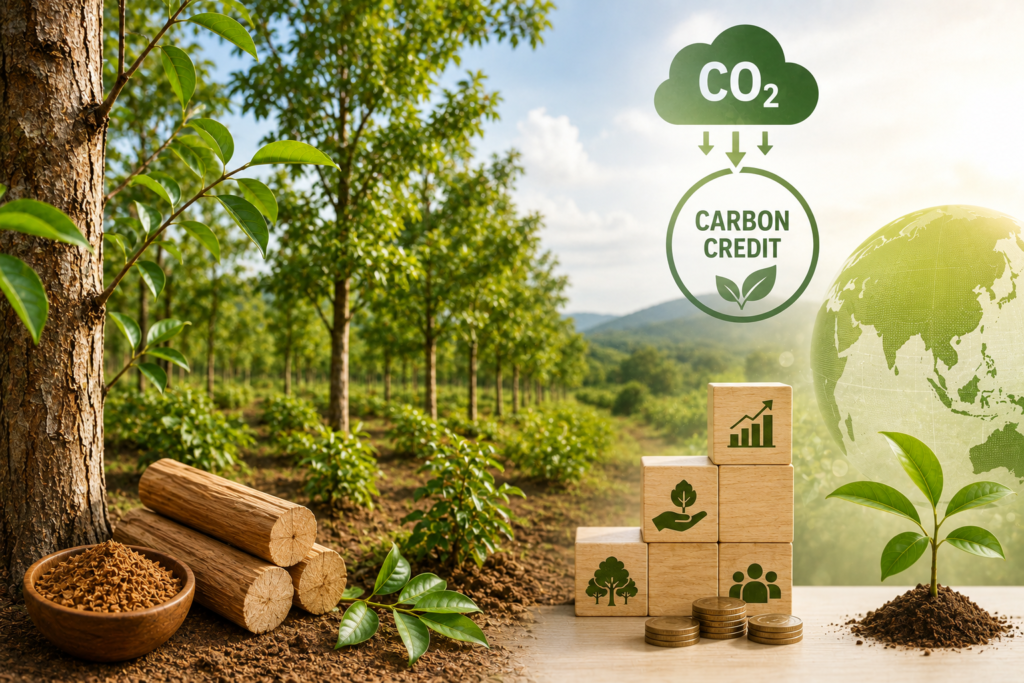
As climate change pushes governments, corporations, and investors to look for credible ways to offset carbon emissions, an unexpected candidate has entered the conversation: sandalwood. Indian Sandalwood’s slow-growing, deeply rooted nature and its role in agroforestry systems have started attracting attention not just for fragrance and oil, but for its potential contribution to carbon sequestration and climate-focused investment models. This blog explores how sandalwood agroforestry intersects with the growing world of carbon credits, and what this could mean for the future of sustainable sandalwood cultivation.
What is Sandalwood Agroforestry?
Agroforestry refers to farming systems that intentionally combine trees with crops or livestock on the same land, creating mutual ecological and economic benefits. Because Indian Sandalwood is hemi-parasitic and depends on host plants throughout its growth cycle, it’s naturally suited to agroforestry-style cultivation, where it’s planted alongside compatible host trees and, in many cases, other agricultural crops.
Research conducted in Karnataka’s Haveri district, for example, has studied how sandalwood performs when grown alongside various secondary host species, evaluating outcomes like heartwood development, oil content, and overall tree growth across different agroforestry combinations. These systems aren’t just about supporting sandalwood’s biological needs, they also allow farmers to generate income from companion crops or trees while waiting the many years required for sandalwood to mature.
Why Carbon Credits are entering the picture?
Carbon credit programs work by financially rewarding projects that measurably remove or reduce greenhouse gas emissions, often through reforestation, afforestation, or sustainable land management practices. Trees are natural carbon sinks, absorbing carbon dioxide from the atmosphere and storing it in their biomass and root systems as they grow.
Given sandalwood’s slow growth and long lifespan, researchers and carbon project developers have begun examining its potential role in these carbon sequestration efforts, particularly when integrated into broader agroforestry or reforestation projects rather than grown as an isolated monoculture crop.
What the Research Shows About Sandalwood and Carbon Sequestration
Scientific studies examining sandalwood’s carbon sequestration potential have produced some interesting, if still evolving, findings.
Natural Sandalwood Forests – Research conducted in the Southern Western Ghats has assessed carbon storage across different land use types, including natural sandalwood forest land. This research found that natural sandalwood forests hold a meaningful carbon stock in their biomass, generally positioning them as a moderate carbon reservoir compared to other land use types like croplands or tea plantations, which showed different carbon saturation dynamics in soil composition.
Agroforestry System Potential – Separately, agroforestry-focused studies have specifically explored the carbon sequestration potential of sandalwood trees grown within mixed-species systems, alongside evaluating more commercially relevant outcomes like heartwood volume and oil content. These studies suggest that integrating sandalwood into agroforestry systems, rather than growing it in isolation, may offer combined benefits: supporting the tree’s biological need for host species while contributing to overall land-based carbon storage.
Broader Agroforestry Climate Potential – More broadly, agricultural and forestry research in India has increasingly highlighted agroforestry’s role in climate change mitigation, noting that combining trees with croplands can meaningfully increase carbon sequestration through both above-ground biomass and below-ground root systems, a principle that extends naturally to sandalwood-based systems given the tree’s multi-decade growth cycle and substantial root development.
Existing Carbon Projects Involving Sandalwood
While large-scale, sandalwood-specific carbon credit programs are still relatively limited, sandalwood has begun appearing within broader reforestation and agroforestry carbon projects, particularly in regions where the species holds ecological and cultural significance.
One notable example is a reforestation project on the Indonesian island of Sumba, where sandalwood, a species historically central to the local economy before colonial-era overharvesting severely depleted wild populations, has been incorporated into a broader agroforestry-based carbon project. This project combines multiple agroforestry models, including mixed fruit and forest tree systems and shade-grown crop integration, aiming to generate certified carbon credits while simultaneously restoring degraded land and supporting local livelihoods. Such projects are typically certified under internationally recognized carbon standards, which require rigorous methodology and verification before credits can be issued and traded.
Why Sandalwood Could Be an Attractive Carbon Investment
Several characteristics make sandalwood an interesting, if niche, candidate for carbon-focused agroforestry investment:
- Long lifespan and slow growth: Trees that take decades to mature typically sequester carbon over a longer, more stable timeframe compared to fast-growing, quickly harvested species.
- Dual economic value: Unlike carbon-only reforestation projects, sandalwood agroforestry can eventually generate additional revenue through heartwood and oil sales once trees mature, creating a potential dual-income model for landowners.
- Root-based carbon storage: As a hemi-parasitic species with an extensive root network connecting to host plants, sandalwood’s below-ground biomass may contribute meaningfully to overall carbon storage, though more dedicated research is needed to fully quantify this effect.
- Alignment with degraded land restoration: In regions where sandalwood populations have historically been depleted, reintroducing the species through agroforestry-based carbon projects can support both ecological restoration and carbon sequestration goals simultaneously.
Challenges and Open Questions
Despite its potential, several challenges remain before sandalwood-based carbon credit models can scale significantly:
- Limited dedicated research: While general agroforestry carbon studies exist, research specifically quantifying sandalwood’s carbon sequestration potential compared to other tree species remains relatively limited.
- Long verification timelines: Carbon credit certification typically requires long-term monitoring and verification, which aligns awkwardly with sandalwood’s already lengthy maturation period, potentially complicating financial modeling for investors.
- Disease and security risks: Ongoing threats like sandal spike disease and theft, given sandalwood’s high value, introduce additional risk factors that could affect the reliability of long-term carbon sequestration projections.
- Balancing land use priorities: Since sandalwood requires host plants and specific growing conditions, integrating it into large-scale carbon offset projects requires careful ecological planning to avoid competing with other agricultural or conservation priorities.
The Bigger Picture: Agroforestry as a Climate and Livelihood Strategy
Beyond carbon credits specifically, sandalwood agroforestry reflects a broader shift toward low-input, high-value tree-based farming systems designed to support both environmental sustainability and farmer income. Indian policy shifts that removed earlier restrictions on private sandalwood cultivation have specifically encouraged farmers to consider sandalwood-based agroforestry as a long-term livelihood strategy, particularly on marginal or underutilized farmland.
As carbon markets continue to mature and demand grows for high-integrity, biodiversity-friendly carbon projects, sandalwood agroforestry could increasingly be positioned not just as a climate mitigation tool, but as part of a broader model for combining ecological restoration, rural income generation, and long-term natural resource conservation.
Conclusion
The intersection of carbon credits and sandalwood agroforestry represents an emerging, still-developing area within both climate finance and sustainable agriculture. While dedicated research and large-scale carbon projects specifically built around sandalwood remain limited for now, the tree’s long lifespan, root-based growth characteristics, and compatibility with mixed-species farming systems suggest meaningful potential for future development. As global interest in nature-based climate solutions continues to grow, sandalwood agroforestry may well become an increasingly relevant part of the conversation, offering a rare opportunity to combine climate action, biodiversity restoration, and long-term economic value in a single, slow-growing tree.