Frequently Asked Questions About Indian Sandalwood Cultivation
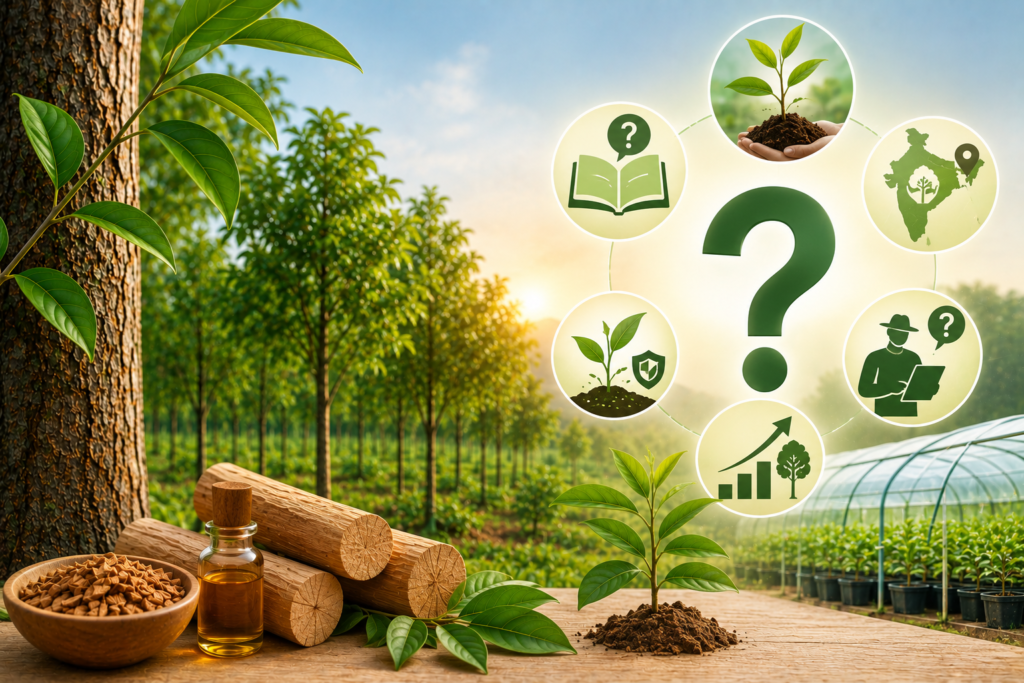
Frequently asked questions about Indian Sandalwood Cultivation, since it has attracted growing interest from farmers, landowners, and investors across India in recent years, especially as policy reforms have opened the door to private, legal cultivation. But because sandalwood farming works so differently from typical crops, it comes with a unique set of questions. This FAQ blog answers the most common queries people have about growing Indian Sandalwood (Santalum album), from basic biology to legal requirements and expected returns.
How long does it take for a sandalwood tree to mature?
Traditionally, sandalwood has been understood to take 15 to 30 years to develop commercially valuable heartwood. However, more recent research and improved cultivation practices suggest that with proper host plant management and modern techniques, some trees can begin forming meaningful heartwood by around 15 years, with certain studies noting heartwood initiation as early as 6 to 8 years under favorable growing conditions. That said, most experts still recommend planning for a long-term investment horizon rather than expecting significantly earlier returns.
Why does sandalwood need a host plant to grow?
Indian Sandalwood is classified as a hemi-parasitic tree. While it performs photosynthesis independently, it cannot absorb sufficient water and nutrients through its own root system alone. Instead, its roots form connections called haustoria with nearby host plants, drawing essential nutrients throughout its life cycle. Without a suitable host, sandalwood saplings typically become weak and often fail to survive their early growth stages.
What are the best host plants for sandalwood cultivation?
Farmers typically use a combination of short-term and long-term host plants depending on the sandalwood tree’s growth stage. Common short-term hosts include pigeon pea (Cajanus cajan) and various fast-growing leguminous shrubs, used during the tree’s early establishment phase. Long-term hosts often include species like Casuarina, Acacia, Dalbergia sissoo, and Melia dubia, which support the tree as it matures over many years. Selecting the right host combination and planting geometry is considered one of the most important factors influencing successful cultivation.
Is it legal to grow sandalwood on private land in India?
Yes, following regulatory reforms introduced over the past two decades, private landowners in most Indian states can now legally cultivate, harvest, and sell sandalwood trees, provided they follow registration and permit requirements set by their respective state governments. This marks a significant shift from earlier decades, when sandalwood was treated as government property even on privately owned land. That said, specific rules around registration, felling permissions, and transit documentation can vary by state, so farmers should check current regulations in their region before planting.
Which Indian states are best suited for sandalwood cultivation?
This is one of the most frequently asked questions on Indian Sandalwood Cultivation. Karnataka and Tamil Nadu remain the traditional heartlands of Indian Sandalwood cultivation, offering climate and soil conditions closely matching the species’ native range. However, cultivation has expanded significantly into states like Telangana, Andhra Pradesh, Gujarat, Rajasthan, Madhya Pradesh, Kerala, and Maharashtra over the past decade, as farmers in these regions have found sandalwood viable despite being outside its traditional growing area.
How much land is needed to start a sandalwood plantation?
There’s no strict minimum land requirement, and sandalwood can be grown on anything from small farm plots to large commercial plantations. Many farmers choose to integrate sandalwood into existing agroforestry or mixed-cropping systems rather than dedicating land exclusively to sandalwood, allowing them to generate income from companion crops while sandalwood trees mature over many years.
What climate and soil conditions does sandalwood need?
Sandalwood thrives in warm, tropical to subtropical climates with moderate annual rainfall, generally between 600 and 1,600 mm. It prefers well-drained, slightly alkaline to neutral soils, though it can tolerate a range of soil types as long as drainage is adequate. Full sun exposure is particularly important during the tree’s early growth stages.
What is sandal spike disease, and how does it affect cultivation?
Sandal spike disease (SSD) is a serious phytoplasma-caused disease that remains one of the biggest threats to sandalwood cultivation in India. Infected trees typically develop small, crowded, yellowish leaves on stiffened twigs, eventually dying within one to two years of visible symptoms appearing. The disease spreads through leafhopper insects and root grafting between trees. Farmers are generally advised to monitor plantations regularly, remove infected trees promptly, and source disease-free planting material through tissue culture propagation to reduce risk.
How much heartwood and oil can a mature sandalwood tree produce?
Heartwood yield varies significantly based on tree age, growing conditions, and cultivation practices. Historically, wild sandalwood trees produced around 25 to 30 kg of heartwood by 27 to 30 years of age. However, some modern cultivation studies suggest that with improved practices, trees with a diameter at breast height of around 15 cm may produce at least 15 kg of heartwood by around 15 years of age. Oil content and quality also vary considerably depending on tree maturity, with older trees generally producing higher-quality, more aromatic oil.
How much does sandalwood sell for, and is it a profitable investment?
Sandalwood pricing varies based on quality grade, but government reference pricing has placed high-quality Class I heartwood in the range of several thousand rupees per kilogram, with sandalwood oil commanding a substantially higher price per kilogram. International market rates are often somewhat higher than domestic Indian prices. While these figures can make sandalwood look like an attractive long-term investment, farmers should factor in the multi-decade wait for returns, ongoing maintenance costs, disease risk, and market price fluctuations before treating it as a guaranteed income source.
Can I get financial support or insurance for sandalwood farming?
Access to dedicated credit and insurance products for sandalwood specifically remains limited, and this is an area industry advocates have flagged as needing improvement. Some state governments offer subsidies or technical support for sandalwood cultivation, and recent central government policy discussions have highlighted the need for better credit and insurance mechanisms tailored to sandalwood’s unusually long investment horizon. Farmers considering sandalwood cultivation should check with their state agriculture or forestry department for the most current support programs available.
How do I protect my sandalwood trees from theft?
Given sandalwood’s high value, theft and illegal logging remain significant concerns for growers, particularly as trees approach maturity. Common protective measures include installing fencing and security systems, maintaining regular monitoring of plantation sites, registering trees with local forestry authorities where required, and in some cases, employing on-site security personnel as trees near harvestable age.
Can I invest in sandalwood plantations without owning farmland myself?
Yes, several private companies now offer structured investment models where individuals can fund sandalwood plantations without owning or managing agricultural land directly. These arrangements typically involve the company handling land, cultivation, and eventual harvesting, with investors receiving a share of profits once trees mature and are sold. As with any long-term investment, it’s worth carefully researching the company’s track record, land ownership structure, and legal compliance before committing funds, since returns are not guaranteed and depend on successful cultivation over many years.
Is sandalwood cultivation environmentally beneficial?
Sandalwood cultivation, particularly when integrated into agroforestry systems, can offer several environmental benefits, including improved biodiversity, soil health, and long-term carbon storage through the tree’s extensive root system and multi-decade growth cycle. That said, successful cultivation requires careful ecological planning, particularly around host plant selection, to ensure the system functions sustainably rather than placing undue stress on surrounding land and resources.
What's the biggest challenge facing new sandalwood farmers today?
While opinions vary, many industry experts point to the mismatch between sandalwood’s long growth cycle and the practical, on-the-ground regulatory and support systems currently in place. Issues like accessing quality planting material, navigating felling and transit permits, securing plantations against theft, and managing disease risk over a 15-to-30-year timeline remain significant hurdles, even as recent policy attention aims to address many of these gaps.
Conclusion
Sandalwood cultivation offers a genuinely unique opportunity among agricultural investments, but it comes with equally unique challenges tied to its biology, disease risks, and evolving regulatory environment. For anyone considering entering sandalwood farming, understanding these fundamentals, and staying updated on current state-specific regulations, is essential before committing land, time, and capital to this slow-growing but potentially rewarding tree.