
History of Indian Sandalwood
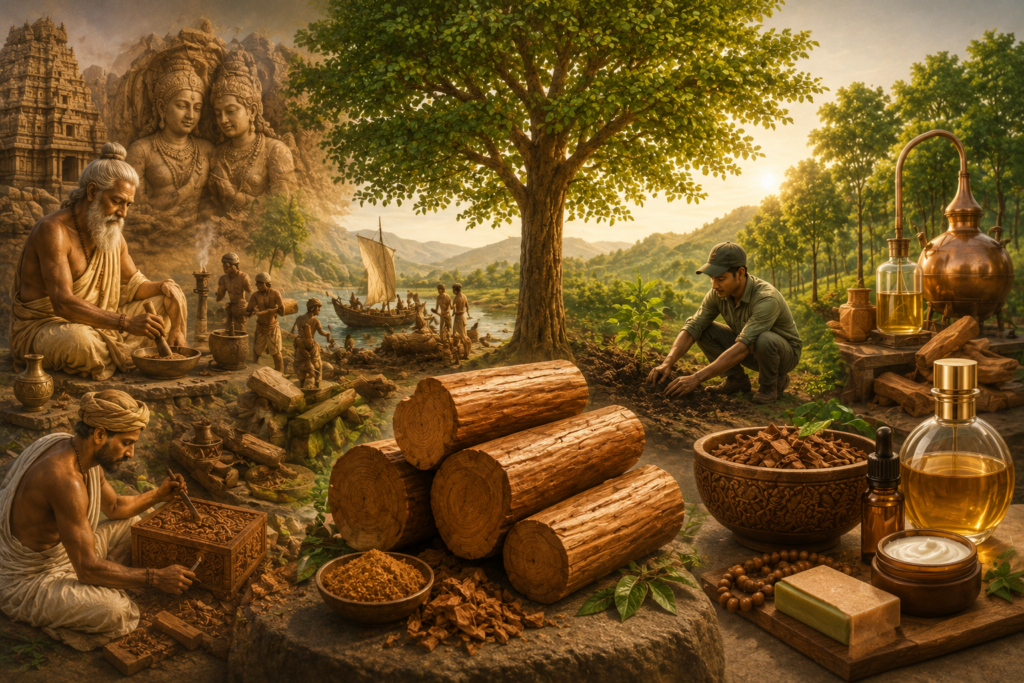
History of Indian Sandalwood stretches back thousands of years, making it one of the most historically significant and culturally valued trees in India. Its fragrant heartwood has been used in temples, royal courts, traditional practices, and ancient trade routes, while its growing economic importance later brought it into colonial records and commercial industries. From its deep cultural roots to its role in shaping regional trade and economies, the story of Indian Sandalwood reflects a fascinating journey through India’s history. This blog explores the origins, evolution, and historical significance of sandalwood and how its legacy continues to influence its value today.
Ancient Origins
The story of Indian Sandalwood begins in the forests of southern India, particularly in what is now Karnataka and Tamil Nadu. Historical and archaeological evidence suggests sandalwood was used in the Indian subcontinent as far back as 3,000 to 4,000 years ago, appearing in early Sanskrit texts and Ayurvedic literature. It was referred to as “Chandana” in Sanskrit, a name still used across India today.
Ancient Ayurvedic scholars documented sandalwood’s cooling and healing properties, prescribing it for skin ailments, fevers, and as a calming agent for the mind. Its role wasn’t just medicinal — sandalwood paste became an integral part of religious rituals, used to anoint deities and mark the foreheads of worshippers as a symbol of purity and spiritual devotion.

Sandalwood in Trade & Ancient Economies
Long before European colonization, Indian Sandalwood was already a valuable trade commodity. Traders carried it along ancient maritime and overland routes connecting India to the Middle East, China, and Southeast Asia. Chinese texts from as early as the first millennium CE reference imported sandalwood, prized for incense used in Buddhist temples and rituals.
By the time of the Mysore Kingdom’s rise to prominence, sandalwood had become deeply tied to South Indian regional identity. The dense forests surrounding Mysore contained some of the finest sandalwood trees in the world, setting the stage for centuries of royal control and trade regulation.
The Mysore Kingdom and Royal Monopoly
One of the most defining chapters in sandalwood’s history took place under the rule of the Kingdom of Mysore. Recognizing the immense economic value of sandalwood forests, the rulers of Mysore — most notably Tipu Sultan in the late 18th century — declared sandalwood a “royal tree.” This meant the wood could not be harvested, sold, or traded without government sanction.
This royal monopoly served two purposes: it protected the resource from overexploitation, and it ensured that profits from its sale flowed directly into the kingdom’s treasury. The tradition of state control over sandalwood harvesting continued long after Tipu Sultan’s era and would eventually be inherited by the British colonial administration.
Colonial-Era Exploitation
When the British East India Company and later the British Crown gained control over the Mysore region, they recognized the immense commercial value of sandalwood, particularly for export to European perfumeries and Chinese markets. The colonial government maintained the state monopoly system, but with an emphasis on maximizing extraction for trade revenue rather than sustainable forest management.
During this period, sandalwood oil distillation became more industrialized. British-established distilleries in Mysore extracted the oil for shipment abroad, feeding growing European demand for sandalwood-based perfumes, soaps, and medicinal products. This period also saw the beginnings of overharvesting concerns, as demand outpaced the tree’s notoriously slow growth cycle.
Post-Independence Regulation
After India gained independence in 1947, the state of Karnataka continued the practice of treating sandalwood as government property, a policy rooted directly in the old Mysore royal monopoly. For decades, private citizens were prohibited from owning, harvesting, or selling sandalwood trees even if they grew on private land — all sandalwood belonged to the state.
While this policy aimed to prevent illegal logging and protect dwindling forests, it inadvertently fueled a massive black market. Smuggling networks emerged, some tied to organized crime, most infamously associated with the sandalwood smuggler and poacher Veerappan, who evaded authorities for years while illegally harvesting and trading sandalwood and ivory across the Karnataka-Tamil Nadu forest belt.
Reform and the Rise of Legal Cultivation
Recognizing that state monopoly laws were failing to curb illegal trade while discouraging private cultivation, Karnataka and other states began reforming sandalwood ownership laws in the early 2000s and 2010s. These reforms allowed private landowners to legally grow, harvest, and sell sandalwood, provided they followed registration and permit requirements.
This shift opened the door for organized plantation companies to invest in large-scale, sustainable sandalwood farming, both in India and in other countries like Australia, which had already developed commercial Santalum plantations decades earlier.
Sandalwood's Legacy Today
Today, Indian Sandalwood sits at an interesting crossroads between ancient tradition and modern regulation. It remains deeply embedded in religious and cultural practices, continues to be a prized ingredient in global perfumery, and is now increasingly sourced from certified, sustainably managed plantations rather than dwindling wild forests.
The journey of Indian Sandalwood — from sacred temple offering to royal monopoly to a regulated, globally traded commodity — reflects broader themes in the history of natural resource management: reverence, exploitation, crisis, and eventual reform.
Conclusion
Understanding the history of Indian Sandalwood adds depth to every stick of incense, drop of oil, or carved artifact made from this remarkable tree. Its story isn’t just about fragrance — it’s about how societies have valued, fought over, and ultimately learned to protect a resource that takes generations to grow but only moments to destroy.