Indian Sandalwood Spike Disease
For all its resilience and historical significance, Indian Sandalwood (Santalum album) faces a serious biological threat that has plagued growers for over a century: sandal spike disease. Considered the most destructive disease affecting sandalwood, it has played a major role in the decline of wild sandalwood populations across India and remains a critical challenge for anyone involved in sandalwood cultivation today. This blog breaks down what spike disease is, how it spreads, and what’s being done to manage it.
What is Sandal Spike Disease?
Sandal spike disease, commonly abbreviated as SSD, is caused by a bacterial pathogen known as a phytoplasma, specifically identified as a strain of Candidatus Phytoplasma asteris belonging to the aster yellows group. Unlike fungal or viral plant diseases, phytoplasmas are wall-less bacteria that live inside a plant’s phloem, the tissue responsible for transporting nutrients throughout the tree.
Research into SSD dates back more than a hundred years, though the disease’s exact causal agent wasn’t confirmed until 1969, when multiple independent research groups identified the phytoplasma responsible through microscopic and biological testing. It took several more decades of advancement in molecular diagnostic techniques, including PCR-based testing, to fully confirm and characterize the pathogen’s genetic identity.
Recognizing the Symptoms
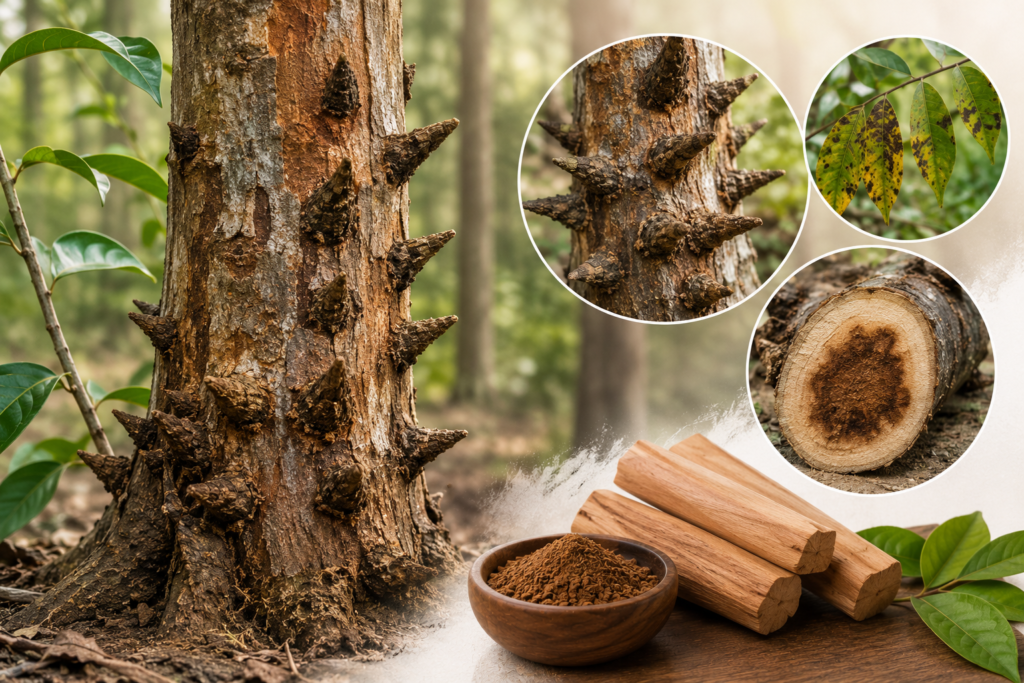
Sandal spike disease gets its name from its most distinctive visual symptom: infected trees develop small, crowded, yellowish leaves along stiffened twigs, giving the affected branches a spike-like appearance, similar to a spike of inflorescence rather than normal, healthy foliage.
Other common symptoms include:
- Extreme leaf size reduction: Leaves on infected branches shrink dramatically compared to healthy foliage.
- Shortened internodes: The spacing between leaves along the stem becomes noticeably compressed.
- Chlorosis: Infected leaves often display yellowing or discoloration.
- Witches’ broom formations: Dense clusters of stunted shoots can form as the disease progresses.
- General decline: Infected trees show reduced vigor and slowed growth as the disease spreads through the plant’s system.
One of the most concerning aspects of SSD is its slow, often silent progression. Infected trees can carry the phytoplasma for a long time before visible symptoms appear, making early detection difficult without specialized testing. Once visible spike symptoms do appear, however, affected trees typically die within one to two years.
How Spike Disease spreads?
Understanding how SSD spreads is essential for managing its impact on sandalwood plantations. The disease spreads through two primary pathways:
Insect Vectors – Leafhoppers are the primary insect vector responsible for transmitting the phytoplasma between trees. As these insects feed on the phloem sap of infected trees, they pick up the pathogen and can transmit it to healthy trees during subsequent feeding, allowing the disease to spread across a plantation or forest area over time.
Root Grafting – As sandalwood is a hemi-parasitic species that naturally forms root connections with host plants and even neighboring sandalwood trees, the disease can also spread through root grafting, where infected root tissue comes into direct contact with healthy root systems, allowing the phytoplasma to transfer between trees underground.
Seed Transmission – Some research has also investigated the possibility of vertical transmission, where the phytoplasma may be passed from infected parent trees to their seeds and resulting seedlings, though the extent and consistency of this transmission pathway continues to be studied using sensitive molecular detection methods.
The Impact on Sandalwood Populations
Sandal spike disease has had a significant, long-term impact on Indian Sandalwood populations, particularly in Karnataka, historically the epicenter of India’s sandalwood forests. Repeated outbreaks over the decades have contributed to notable population decline, playing a major role in Santalum album now being classified as a threatened species on international conservation assessments.
This ongoing pressure from SSD, combined with historical overharvesting, has made disease management a top priority for both government forestry departments and private cultivators looking to protect existing sandalwood stands and expand sustainable plantations.
Diagnosing Spike Disease
As early-stage infections often show no visible symptoms, accurate diagnosis has historically been a major challenge in managing SSD. Older diagnostic methods relied on biological indexing, histopathological examination, and electron microscopy, approaches that were often slow, resource-intensive, and sometimes inconclusive.
More recently, researchers have developed molecular diagnostic techniques, including nested PCR and loop-mediated isothermal amplification (LAMP) assays, that allow for faster, more reliable detection of phytoplasma presence in tree tissue, even before visible symptoms develop. These advances are helping researchers and forestry managers identify infected trees earlier, improving the odds of containing outbreaks before they spread further.
Current Management Strategies
While there’s currently no complete cure for sandal spike disease once a tree is infected, several management strategies have been developed to help reduce its spread and impact:
- Removal of infected trees: Promptly identifying and removing symptomatic trees helps reduce the risk of further transmission to healthy trees nearby.
- Vector control: Managing leafhopper populations through monitoring and targeted control methods can help reduce the insect-driven spread of the disease.
- Careful root management: Avoiding root contact between trees, particularly in dense plantations, can help limit transmission through root grafting.
- Tissue culture propagation: Producing disease-free planting material through tissue culture techniques offers a promising way to establish new plantations using verified healthy stock.
- Ongoing monitoring: Regular molecular testing of plantation trees, especially in high-risk regions, allows for earlier detection and more effective containment efforts.
The Search for Disease-Resistant Sandalwood
Given the limitations of current management approaches, researchers have increasingly turned their attention toward developing disease-resistant sandalwood varieties. Some studies have explored genetic transformation and selective breeding techniques aimed at producing sandalwood trees with greater natural resistance to phytoplasma infection.
While this research remains in relatively early stages, many experts consider the development of resistant cultivars, combined with disease-free tissue culture propagation, to be among the most realistic long-term solutions for protecting sandalwood populations from the ongoing threat of spike disease.
Why This Matters for the Future of Sandalwood
As global demand for Indian Sandalwood continues to rise, and cultivation increasingly shifts toward private plantations to meet this demand, effectively managing spike disease has become more important than ever. Without continued research and proactive management, SSD could significantly undermine efforts to rebuild sustainable sandalwood populations, both in India and in other regions now exploring sandalwood cultivation.
Conclusion
Sandal spike disease remains one of the most significant challenges facing Indian Sandalwood today, with a long history of impact on wild and cultivated populations alike. While modern diagnostic tools and management practices have improved growers’ ability to detect and contain outbreaks, a complete, scalable solution likely depends on continued research into disease-resistant sandalwood varieties. For anyone involved in sandalwood cultivation, staying informed about SSD and its management remains essential to protecting this valuable, slow-growing tree for future generations.