Sandalwood and Host Plants
Ask any sandalwood farmer what the secret to a healthy plantation is, and they won’t just talk about soil or rainfall — they’ll talk about host plants. Indian Sandalwood (Santalum album) is one of the few commercially important trees that literally cannot survive to maturity on its own. Its entire growth cycle depends on forming underground connections with other plants, making host selection one of the most critical decisions in successful sandalwood cultivation. This blog takes a closer look at why sandalwood needs hosts, how the relationship works, and which plants make the best companions.
Why Sandalwood Needs Host Plants
Sandalwood is classified as a hemi-parasitic plant. Unlike fully parasitic plants that rely entirely on a host for survival, sandalwood still performs photosynthesis and produces its own food using sunlight. However, it cannot independently absorb enough water, nitrogen, and essential minerals through its own root system alone.
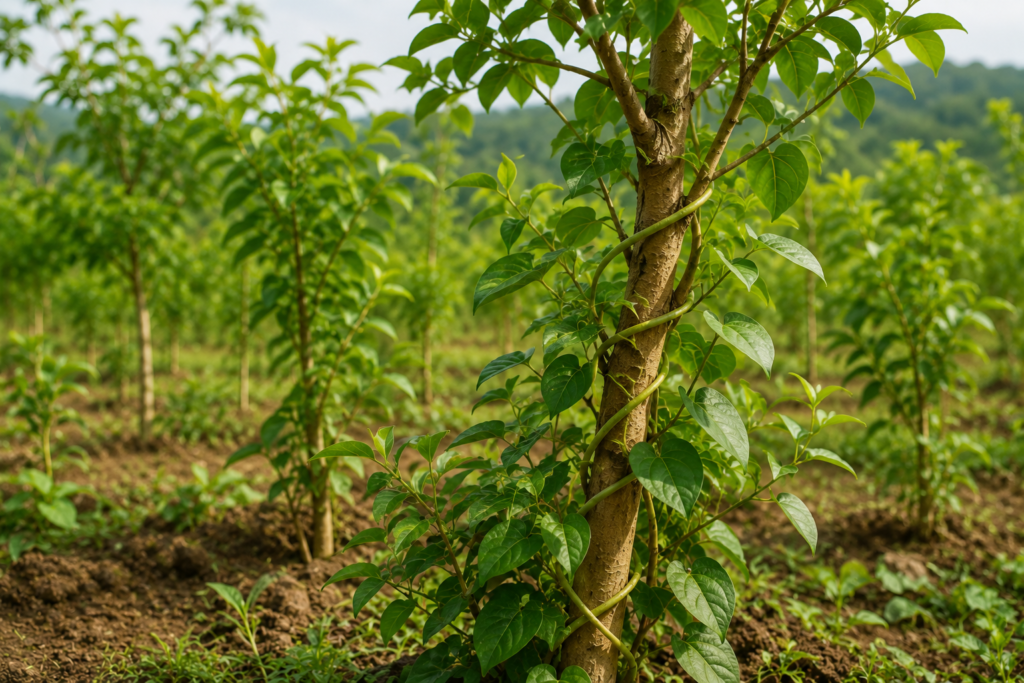
To compensate, sandalwood roots form specialized structures called haustoria, which attach to the roots of nearby plants. Through these connections, sandalwood draws water and nutrients directly from its host, supplementing what it cannot obtain on its own. Without this partnership, sandalwood saplings typically become stunted, weak, and often die within the first few years of growth.
How the Host Relationship Works?
The relationship between sandalwood and its host isn’t a simple one-time connection — it evolves as the tree matures. Younger sandalwood plants generally form connections with multiple smaller host plants nearby, drawing modest nutrient support during their early establishment phase. As the sandalwood tree grows larger and its nutrient demands increase, it often shifts toward forming connections with larger, more established host trees capable of supporting its expanding root system.
Interestingly, sandalwood doesn’t rely on just one host throughout its life. Research and field experience have shown that a single sandalwood tree may connect with several different host plants simultaneously or sequentially across different growth stages, creating a complex underground network that supports its long journey to maturity.
Categories of Host Plants
Sandalwood cultivation typically involves two broad categories of host plants, each serving a different purpose depending on the tree’s age.
These are fast-growing plants introduced during the earliest stages of sandalwood cultivation, usually within the first one to three years. Short-term hosts are chosen for their quick establishment and ability to support young, vulnerable saplings. Common short-term hosts include:
- Pigeon pea (Cajanus cajan): A fast-growing legume that also enriches soil nitrogen levels.
- Sesbania species: Quick-growing shrubs often used as temporary nurse plants.
- Various other leguminous shrubs: Chosen for their nitrogen-fixing properties, which benefit both the host and the sandalwood sapling.
As sandalwood trees mature beyond their initial establishment phase, they require sturdier, longer-lived hosts capable of supporting them for years or even decades. Common long-term hosts include:
- Casuarina species: Widely used due to their extensive root systems and compatibility with sandalwood’s nutrient needs.
- Acacia species: Known for nitrogen fixation and strong root structures suitable for long-term partnerships.
- Pongamia pinnata: A hardy tree often used in South Indian sandalwood plantations for its resilience and nutrient-sharing capacity.
Using a combination of short-term and long-term hosts throughout a sandalwood tree’s growth cycle helps ensure consistent nutrient support from the sapling stage all the way to full maturity.
What Makes a Good Host Plant?
Not every plant is suitable as a sandalwood host. Successful host plants generally share a few key characteristics:
- Compatible root systems: Hosts need root structures that allow sandalwood’s haustoria to attach effectively.
- Nitrogen-fixing ability: Many preferred hosts, particularly legumes, enrich the surrounding soil with nitrogen, indirectly benefiting the sandalwood tree.
- Non-competitive growth habits: Ideal hosts shouldn’t compete too aggressively with sandalwood for sunlight or space, especially in the tree’s early years.
- Longevity matching growth stage: Short-term hosts should establish quickly, while long-term hosts need the durability to support sandalwood for many years.
The Consequences of Poor Host Selection
Choosing the wrong host plants, or failing to introduce hosts at the right growth stages, can severely impact a sandalwood plantation’s success. Common issues resulting from poor host management include:
- Stunted growth: Without adequate nutrient support, sandalwood saplings often fail to develop properly, delaying or preventing heartwood formation.
- Increased mortality rates: Young sandalwood plants without suitable hosts have significantly higher failure rates in their first few years.
- Reduced oil quality: Even if a tree survives with inadequate host support, poor nutrient access can affect the eventual concentration and quality of its aromatic heartwood oil.
This is why experienced sandalwood cultivators place as much emphasis on host plant selection and management as they do on caring for the sandalwood trees themselves.
Research and Evolving Best Practices
As commercial sandalwood cultivation has expanded in recent decades, researchers and agricultural institutions across India and countries like Australia have conducted extensive studies to identify optimal host plant combinations. This ongoing research has helped refine best practices, including recommended host-to-sandalwood planting ratios, ideal spacing between hosts and sandalwood saplings, and timelines for introducing different host types as trees mature.
These evolving guidelines have significantly improved survival rates and growth outcomes in modern sandalwood plantations compared to earlier, less structured cultivation attempts.
Conclusion
The relationship between Indian Sandalwood and its host plants is one of the most fascinating aspects of this already remarkable tree. Far from being a simple crop that can be planted and left to grow, sandalwood cultivation requires a deep understanding of plant biology, careful host selection, and ongoing management across decades. For anyone interested in growing sandalwood, or simply curious about what makes this tree so unique, understanding its dependence on host plants offers a whole new appreciation for the patience and expertise required to bring a single sandalwood tree to maturity.